Lead and Copper
Corrosion Control Program
The City of Portsmouth implemented a Lead & Copper Corrosion Control Program in 2003 and has been in compliance with its requirements ever since. The general purpose of the Corrosion Control Program is to minimize the potential for water supplied by the City to leach potentially harmful metals such as lead and copper from pipes, fixtures, and solder containing lead. In most cases, lead and copper found in drinking water originate from internal plumbing systems within homes and other privately owned buildings, including the service lines connected to those properties, depending on the materials used. The City’s water supply sources themselves do not contain measurable levels of lead.
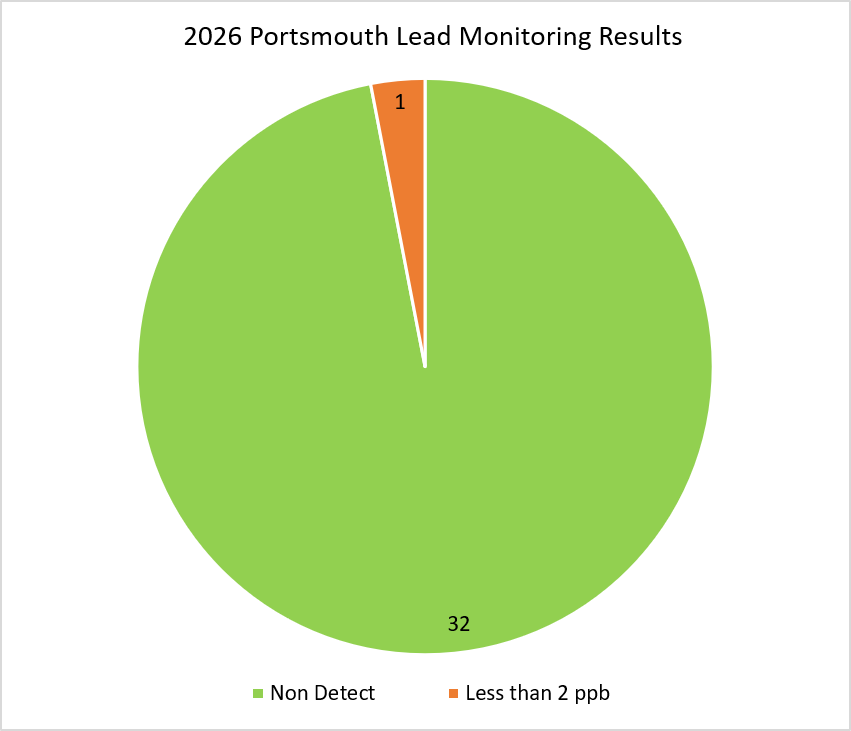
In 2026, 33 homes served by the Portsmouth Water System were sampled for lead and copper analysis. Of these, 32 samples had no-detection of lead above the laboratory detection limit of 1 part per billion (ppb or ug/L), and only one sample had a detected lead concentration of 1-ppb. No samples exceeded the 15-ppb action level. The average concentration of copper found across the same sample set was 0.05 parts per million (ppm or mg/L) and the state-regulated action level for copper in drinking water is 1.3-ppm.
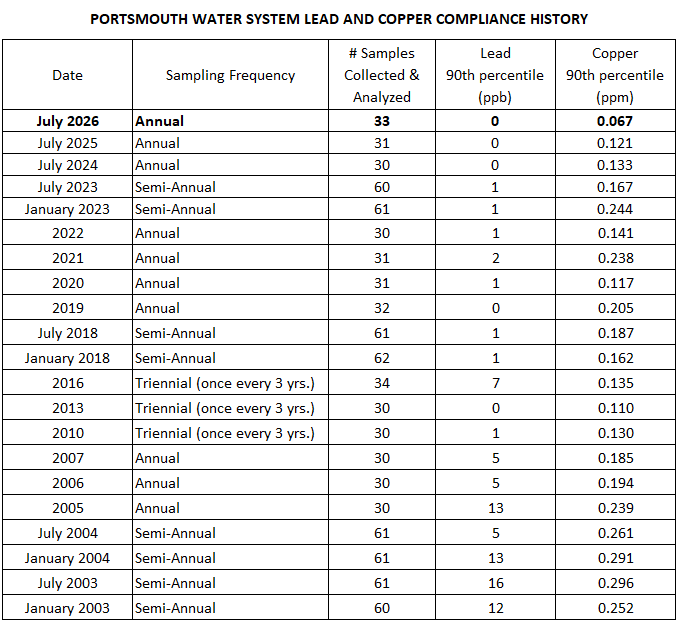
The following is a summary of the lead and copper compliance testing results and sampling schedule for the Portsmouth Water System since the Corrosion Control Program has been in place:
Corrosion Control Inhibitor
To reduce the potential for City water to leach lead and copper from plumbing systems, a corrosion control inhibitor is added to the water supply. The corrosion inhibitor used by the City of Portsmouth is an orthophosphate/polyphosphate blended chemical that is a National Sanitation Foundation (NSF) Standard 60 additive approved for drinking water. The inhibitor creates a coating on the walls of distribution pipes and house plumbing to minimize the potential for metals (including lead and copper) to leach from pipes into the drinking water. It adds no noticeable taste to water. The optimized concentration in the Portsmouth water distribution system is 1 mg/L – as orthophosphate.
Ongoing Monitoring
Portsmouth Water Treatment Operators continuously monitor the concentration of orthophosphate in the system. Field measurements, and laboratory verification samples are analyzed to ensure optimized concentrations are maintained throughout the system. Additional water quality parameters that are factors in the corrosivity of water include alkalinity, hardness, dissolved solids, and pH. The pH is continuously monitored and adjusted in the same fashion as orthophosphate, and alkalinity is monitored daily. The remaining parameters are monitored quarterly from the supply sources and selected locations throughout the distribution system.
Compliance Sampling
As part of the Corrosion Control Program development, locations of representative residential household sampling sites are identified based on the five-tier priority ranking defined by the US Environmental Protection Agency (USEPA). Only those sampling sites that are approved by the New Hampshire Department of Environmental Services (NHDES) can be used for compliance sampling. The current tiered priorities are based upon the following site characteristics:
- Tier 1 – Single-family home served by a lead service line (LSL)
- Tier 2 – Other buildings served by a lead service line (LSL)
- Tier 3 – Single-family home served by a galvanized service line (requiring replacement)
- Tier 4 – Single-family home with copper and leaded solder
- Tier 5 – Other representative site
During the first two years of the Corrosion Control Program, lead and copper compliance samples were collected twice a year from 30 designated sites. After confirming the program’s effectiveness, the sampling frequency was reduced to once a year from 2005 to 2007, and then to once every three years.
At the end of 2022, a new groundwater source was introduced to the Portsmouth Water System. As a result, both the number of required samples and the sampling frequency doubled in 2023 due to the blending of this new water source with the existing supply. Upon confirmation of the effectiveness of the Corrosion Control Program, the monitoring schedule was scaled back again in 2024 and has since remained through 2026.
Public Outreach
As the Portsmouth Water System has not yet identified any lead service lines within its distribution network, the Water Division has located 128 galvanized service lines. These compliance monitoring sites classified as "Tier 3" have been included in the current sampling pool. At the start of July, customers residing in single-family homes served by galvanized service lines received a formal letter inviting them to participate in the lead and copper sampling program. Every sample collected and analyzed for lead and copper in 2026 came from these characterized locations.
All of the participants in the residential compliance sampling program have received results of their lead and copper analyses with a detailed explanation. Lead and copper results are also available on the NHDES OneStop website.
Information about Portsmouth’s Corrosion Control Program has been distributed annually since its inception. Lead and copper information is summarized in the Portsmouth Water Division Annual Water Quality Reports.
Testing Lead in Drinking Water in Schools and Daycares
New Hampshire law (RSA 485:17-a) requires all public and nonpublic schools and licensed child care programs to sample for lead in drinking water at outlets where water is available for consumption by children. Examples of drinking water outlets include drinking fountains, classroom sinks and kitchen fixtures. Sampling is required whether a facility’s water comes from a well or a town/city public water system. The legislation was enacted in February 2018 by Senate Bill 247 and revised with the passage of House Bill 1421 in July 2022. This law reduces the acceptable lead standard for schools and daycares from 15 ppb to 5 ppb, and sets forth sampling and remediation requirements. Any locations that have 5 ppb or higher of lead must be remediated. These programs are being administered by the NHDES and they are working directly with schools and daycares to gain compliance with this rule. All sample results are available on the NHDES website.