
Teacher Effectiveness Plan
A Guide for Professional Staff
Portsmouth School Department, SAU 52 | School Year 2026 to 2027
This guide is in three parts. This page covers the plan itself. Your Evaluation Year covers the timeline, goals, and forms. Your Rights and Status covers probationary status, continuing contract, and your rights under the agreement.
On This Page
- Why This Changed
- The Three Words That Matter
- The Four Evaluation Categories
- How Your Evaluation Category Is Determined
- Questions
Why This Changed
Focus Area 2 of the Strategic Plan commits this district to improving the professional feedback educators receive. Over the past year, that work examined two dimensions of feedback: its quality, including how video might support reflection on practice, and its cadence, meaning how often feedback actually happens.
The finding on cadence was hard to argue with. Under the prior plan, staff on the three-year cycle could go years without a true evaluative conversation. So the district made a decision about sequence: cadence first. Guarantee every professional staff member written feedback every year, then keep improving quality from that foundation. The single fastest improvement in feedback quality is going from no feedback to feedback.
Better and more frequent feedback improves educator quality, and educator quality is the engine of the Portrait of a Graduate, the Board-approved framework anchoring the Strategic Plan through its six pillars: Passion for Knowledge, Global Awareness and Community Contribution, Collaboration and Communication, Transferable Skills, Personal Well-Being, and Empathy and Kindness. Students develop those capacities in classrooms led by educators who are themselves growing, and educators grow on feedback.
Board Policy GCO, re-approved June 9, 2026, requires annual written evaluations for all professional staff. That is the compliance floor beneath this work. The professional reason above is the actual reason.
| Focus Area 2 commits us to better feedback; the redesigned Teacher Effectiveness Plan delivers the cadence half of that commitment this year; better feedback builds educator quality; and educator quality is how the Portrait of a Graduate becomes real for students. |
The Three Words That Matter
This relaunch depends on every building using the same words to mean the same things. Two terms from earlier drafts are retired. We no longer say track, which already has a defined meaning in the salary schedule of the APT agreement, and the ordinary post-Induction category is Established rather than Continuing, which collided with continuing contract status.
Walkthrough
A brief, typically unannounced classroom visit. It is documented, and you receive written feedback within five school days. There is no pre-conference. A follow-up conversation happens at the administrator's discretion or at your request. A walkthrough is a data point, not a verdict.
Formal Observation
A scheduled, full-length observation with a defined arc: pre-observation conference, the observation itself, and a post-observation conference. Formal observations apply to Induction staff and to staff on a Collaborative Growth Plan or a Directed Improvement Plan. They are not part of the ordinary Established year.
Evaluation
The annual written document. It synthesizes the year's walkthroughs, any formal observations, and your goals into a domain-by-domain summary. It is signed, subject to the ten-school-day written comment period under Article 25.6, and filed in the personnel file.
| Only the annual written document is the evaluation. An observation is never an evaluation. Every staff member, every year, receives an evaluation. What varies by evaluation category is the observation activity that feeds it. |
The Four Evaluation Categories
Forms and rosters use the field label Evaluation Category, with one of these four names entered. The categories are spoken by name, with no umbrella noun attached.
| Category | Who is in it | What happens annually |
|---|---|---|
| Induction | Staff new to the profession, and staff new to the district. See below for how long. | One formal observation with pre-conference and post-conference, plus a minimum of three walkthroughs with feedback. |
| Established | Staff who have completed Induction and are not currently on a Collaborative Growth Plan or a Directed Improvement Plan. Goals and professional growth happen here. | A minimum of one documented walkthrough, with a post-conversation upon request, plus goals on file in Frontline. |
| Collaborative Growth Plan | Staff working on a single named area of focus. Entered either at the staff member's request or on a supervisor's determination supported by documented evidence. | A minimum of three walkthroughs, or one formal observation with feedback, at the administrator's discretion. A two-year cap applies only to supervisor-assigned plans. |
| Directed Improvement Plan | Staff with multiple domains of concern, or a single significant deficiency. | Three documented walkthroughs and two formal observations. Maximum duration one calendar year. |
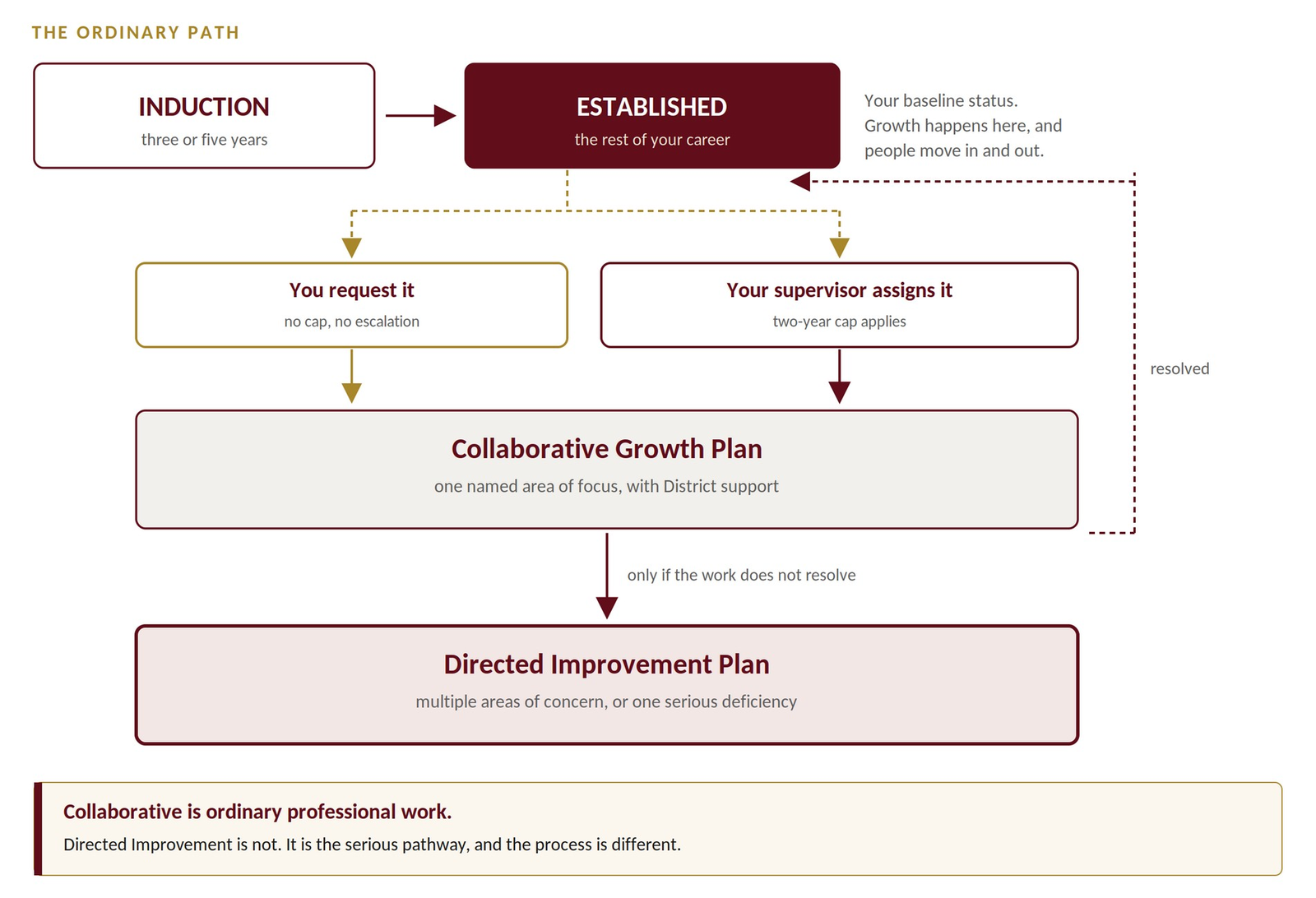
A Collaborative Growth Plan is ordinary professional work. It is a year of focused attention on one part of practice, with District support attached, and a staff member may ask for one. Over a career, moving between Established and a period of focused work is what a learning organization looks like, not a mark against anyone. A Directed Improvement Plan is a different thing entirely. It is the serious pathway, it is entered only on documented evidence, and the process that follows is different.
The four evaluation domains are unchanged: Planning and Preparation, Environment and Culture, Instruction and Service Delivery, and Professional Responsibilities.
How Your Evaluation Category Is Determined
Your evaluation category is set by where you are in your career in this district, not by your certification cycle and not by your educator license type. Every staff member is evaluated annually regardless of category.
Induction
All staff new to the Portsmouth School Department begin in Induction. How long Induction lasts depends on prior service, and the rule follows the probationary period established by New Hampshire law, explained on the Your Rights and Status page.
- If you have previously taught five consecutive years or more in a New Hampshire school district, Induction runs three consecutive years in Portsmouth.
- If you have not, Induction runs five consecutive years in Portsmouth.
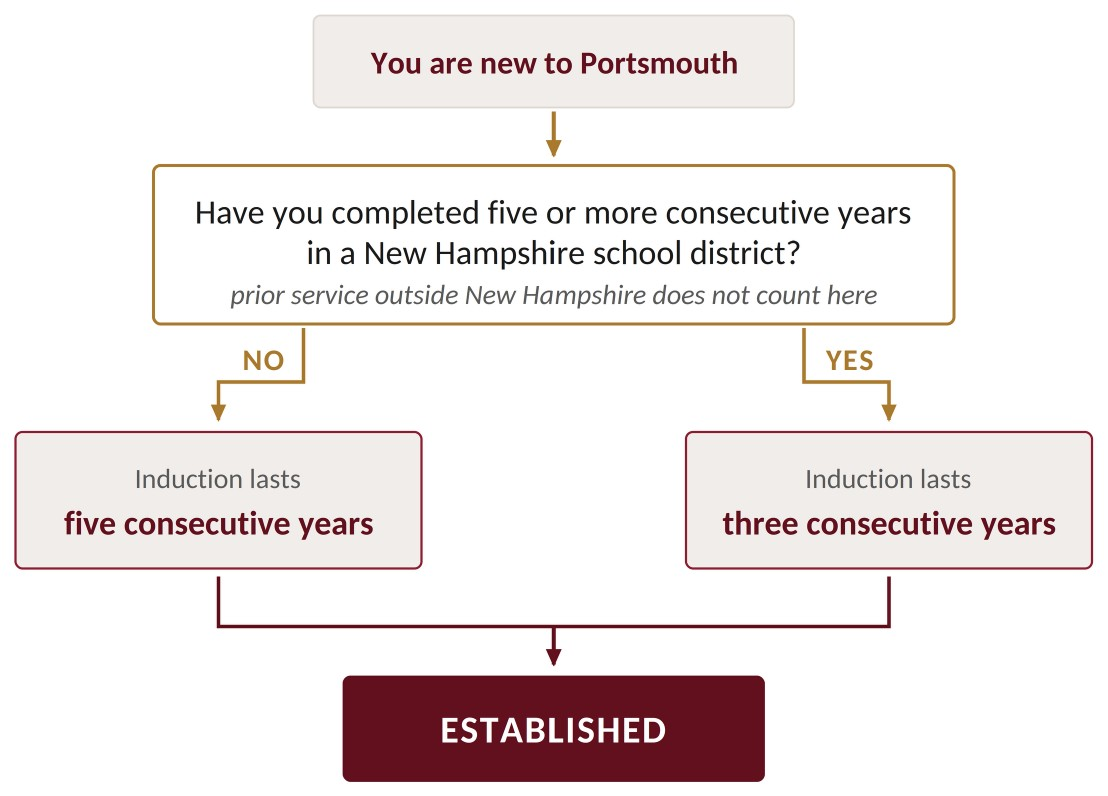
| This is not a district preference. New Hampshire law draws the distinction, and it draws it around service within the state. Prior teaching experience in Maine, Massachusetts, another state, or outside the United States is valued in hiring and in salary placement, but it does not shorten the Portsmouth Induction period. Your Rights and Status explains the statutory basis. |
One further rule follows from the statute. A leave of absence does not interrupt the consecutive nature of your service, but the time on leave does not count toward it either. The clock pauses rather than resets. This rule applies to this determination only. It does not affect how service is computed for salary step, seniority, or any other purpose.
Established
You are Established when you have completed Induction and are not currently on a Collaborative Growth Plan or a Directed Improvement Plan. There is no application or approval step. It happens on completion of the Induction period.
Established is a status, not a verdict, and it is not meant to be a permanent address. Being Established does not mean growth has stopped: your goals live here, and so does the work you choose to do on your practice. In a district that takes professional learning seriously, people move between Established and a period of focused work more than once in a career. Moving is not a sign that something has gone wrong.
Confirmation
Principals enter every staff member's evaluation category in September, and central office confirms every placement by September 30. Nobody should be guessing about anyone's status past that date. If you are unsure of your category, ask your principal.
Questions
Am I Established?
If you have completed Induction and are not on a Collaborative Growth Plan or a Directed Improvement Plan, yes. Your principal confirms every placement by September 30.
What happened to the three-year cycle?
It is gone. Every staff member is evaluated annually.
Does more evaluation mean more surveillance?
No. For the overwhelming majority of staff, the written evaluation will say what is true, which is that you are doing strong professional work, with perhaps a note about something worth continued attention. The change is more feedback for everyone, every year.
Can I ask for a Collaborative Growth Plan?
Yes. If there is an area of your practice you want to work on with support attached, ask your supervisor. A plan you request has no cap and does not lead anywhere except back to Established when you are ready. That is a real difference from a plan a supervisor assigns, and Form 3 records which one it is.
Is a Collaborative Growth Plan a bad sign?
Not in itself. It is a year of focused work on one part of practice, and people arrive there by two different routes. Over a career, moving between Established and a period of focused work should be an ordinary thing rather than a rare one. A supervisor-assigned plan does follow from a documented area of focus, and your supervisor will have told you that directly before the plan opens. Nobody is placed on a plan as a surprise.
I have fifteen years of experience in another state. Why am I in Induction for five years?
Because the probationary period set by New Hampshire law runs five years in this circumstance, and the district has aligned its supervision system to that window so that both describe the same thing. Your experience is real and valued. The Your Rights and Status page explains the statutory basis.
Does this apply to non-teaching professional staff?
The commitment to annual written feedback applies to everyone. The process described here is the teacher evaluation plan. Your supervisor will walk your group through what the commitment looks like in your role.
What happened to the video feedback work?
It is alive. It belongs to the quality conversation, which continues this year. We sequenced cadence first.
Continue
- Your Evaluation Year: the annual timeline, goals, and the forms.
- Your Rights and Status: probationary status, continuing contract, and your rights.