When Will Portsmouth Transition?
The City of Portsmouth will transition to automated trash and recycling collection in several phases. Certain neighborhoods that are more conducive to a ASL truck will be rolled out first, such as Elwyn Park, Maple Haven and Pannaway Manor.
Pilot Program
For the pilot program, one ASL truck will be deployed to cover the pilot area. The pilot program will allow for a gradual transition and time to address any concerns before rolling out the change to all collection stops that are ASL feasible, creating a more efficient city-wide transition. Carts and educational materials will be provided to residents in advance in preparation for the change.
Why the change?
Refuse collection consistently ranks among the most dangerous jobs in America; the change from manual rear-loader trucks to an ASL truck is intended to improve staff safety and increase operational flexibility. The reduction in sanitation staff per truck allows staff to focus efforts on other highway department needs and may lead to increased hours of operation of the City’s transfer station and future swap shop. In addition to safety, solid waste collection frequently calls other highway department staff away from their daily duties to fill in due to injuries and illnesses.
New Standard Cart Sizes & Quantities
Residents will receive one 64-gallon cart for recycling and one 64-gallon cart for trash. Recycling carts will be designated by a blue lid. Multi-family parcels with more than one dwelling unit will receive a set of carts for every unit, up to a maximum of four sets (eight containers total; four trash and four recycling). Any parcel with more than four units is considered a commercial property and trash collection is completed by a private firm. Property owners of multi-units may contact us to request fewer carts. Commercial properties and any property with a dumpster will not receive carts.
Cart Accommodations
At a future date, different cart sizes (45 gallon or 96 gallon) will be available to residents based on availability and eligibility. Different cart sizes are available to senior citizens (ages 65+), households with more than five people, and residents requiring ADA or other accommodations. Residents in the pilot program may request to change the default cart sizing for both carts, or keep the default size of one cart and change the other.
Different Cart Size Requests
Participants in the pilot program may submit a request to receive different cart sizes, based on availability and eligibility. Call Portsmouth DPW at 603-427-1530 or fill out the online request form below. Please DO NOT submit this form if your household is not in the pilot program. At this time, we are only accepting requests for the pilot program.
How to Use Your Toter
- Roll the toter out to the curb by 6 am on your collection day.
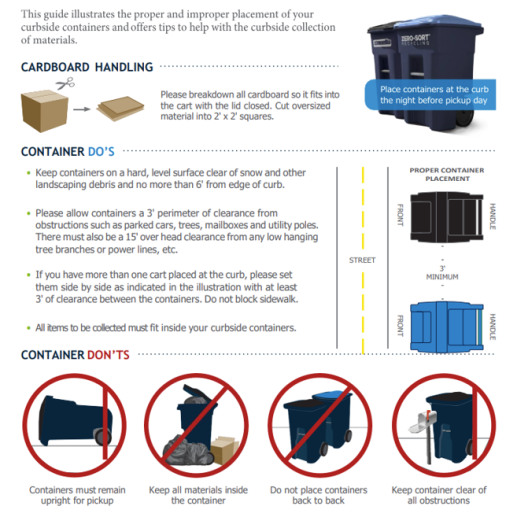
- Wheels should be facing the house (away from the street), so the opening of the top faces the street.
- Place the toter no more than three (3) feet away from the curb and at least three feet away from other containers, such as toys, a fence or your recycle toter.
- No waste material left outside the toter will be collected. All refuse must fit in the toter so the lid closes. No material should be left sticking out of the toter.
- The truck's lifting arm needs three feet on either side of the rolling cart to wrap around the toter. Do not place toters behind parked cars or other obstructions.
- Place the toter away from low phone or electrical wires, low hanging tree branches or other overhead obstructions. A twelve (12) foot vertical clearance is necessary for the truck's lifting arm to elevate the toter.
- Be sure the arrows on the lid are pointing toward the street and the hinges face away from the street. This allows the lid to open fully when the toter is tipped over above the truck bay. If the hinges face the wrong way, the lid or hinges may be damaged.
- Only one toter is allowed per household unit. An ADU (Accessory Dwelling Unit) is defined per RSA 674:71 as a residential living unit that is within or attached to a single-family dwelling, these units are not eligible for a separate toter.
- Old toters that are not compatible with the new system may be dropped off at DPW to be recycled.
Common Questions
What will remain the same?
Scheduled collection days will remain the same and continue once per week. Time of collection may vary. Single-stream recycling will continue. Not all areas of the City are conducive to using an ASL truck; congested areas with compact streets like the South End and Atlantic Heights will continue to utilize the traditional rear-load trucks for collection.
What will change?
Residential properties presently receiving curbside trash and recycling collection will be provided carts from the City at no additional charge. Carts must be used for automated collection. All carts must remain with the property and should not be moved to another location. Each cart will have a serial number associated with the property address. The City's current recycling bins will no longer be usable for automated collection. Trash bags will not be collected if placed at the curb outside of the new trash carts. All materials, including cardboard, must be placed inside carts for collection. At a future time, certain collection routes may change to better suit the use of an ASL truck. These changes will be well communicated when they are to occur.
What if my container is stolen or damaged?
Each household will receive one specialized container. You are responsible for the security of the container. In the event of damage caused by the City or normal wear, the City will replace the container free of charge. Damages resulting from negligence or abuse by the resident will be the responsibility of the resident. Toters cost $100 to replace.
What kind of refuse may be put out in the containers?
All regular household refuse can be placed in the containers provided. Residents are responsible for keeping their containers clean. Items that cannot be placed in the container include:
• Dirt, sod, concrete or rock
• Construction/demolition debris
• Recyclables in the general waste toter
• Household hazardous waste, animal wastes
• Hot ashes or flammable materials such as oil, gas or paint
• Leaves and grass clippings (per NH DES)
• Lithium Ion Batteries- All lithium ion batteries and devices containing them must be dropped off at DPW. DO NOT THROW THEM INTO YOUR HOUSEHOLD WASTE CONTAINER.
I'm cleaning out the garage and have a lot of refuse to get rid of right away. Where can I dispose of it?
The automated refuse collection program is not intended to provide this type of service. The resident must be responsible for the disposal. Please contract DPW to schedule a bulky waste pickup or bring larger quantities of refuse to the transfer station at 680 Peverly Hill Road during normal business hours.